Improper Installation
Wrong fastener spacing or torque, missing expansion allowance, and rushed flashing details can undermine otherwise durable metal panels.
At Phoenix Commercial Roofing Company, inspections of commercial metal roofs in Phoenix and across the Salt River Valley show that the biggest problem is improper installation, not the metal itself. Fastener spacing, expansion allowance, and flashing details determine whether a system performs for decades or leaks early.
Wrong fastener spacing or torque, missing expansion allowance, and rushed flashing details can undermine otherwise durable metal panels.
Repeated expansion and contraction can back fasteners out, while UV exposure hardens the neoprene washers that seal them.
Check fasteners, sealant, laps, seams, penetrations, transitions, valleys, and flashing before blaming the open metal panels.
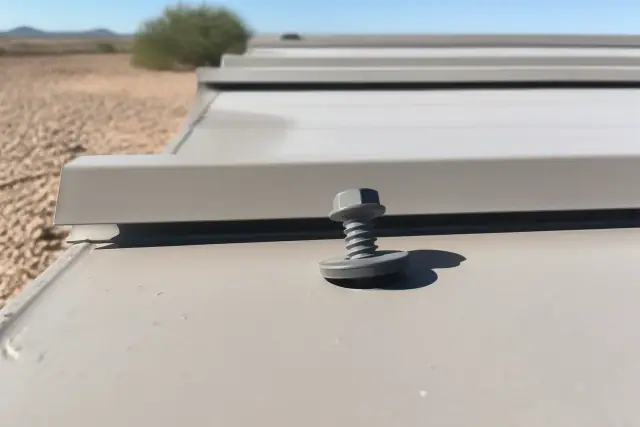
A raised fastener beside a neoprene washer that has cracked or hardened after UV exposure illustrates a potential path for water entry.
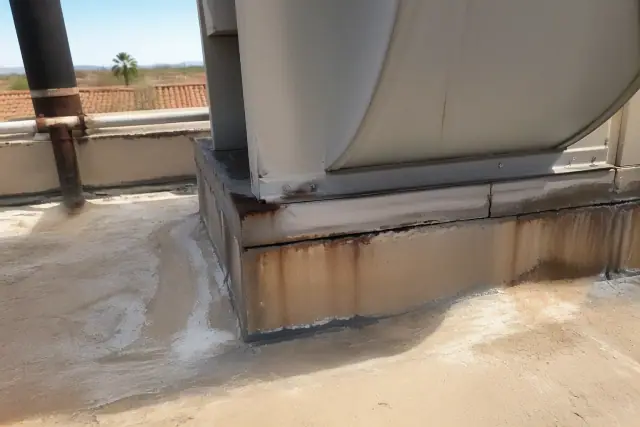
Separated sealant or flashing around a commercial rooftop penetration highlights why leaks cluster at these details and transitions rather than through open panels.
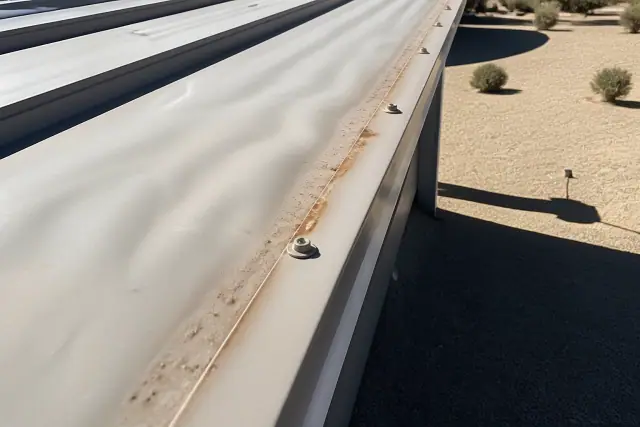
Waviness across a flat metal pan may indicate oil canning, while rust beginning at a cut or scratched edge points to material damage.
Water entry is far more likely at a seam, valley, flashing, penetration, endlap, or transition than through an undamaged panel field.
Fastener movement, washer hardening, and sealant breakdown commonly appear before the metal panels reach the end of their service life.
Daily shifts from 115°F afternoons to cooler nights drive repeated panel movement and more thermal fatigue than in milder climates.
Dissimilar fasteners, flashing, and panels can create galvanic corrosion when the materials are not matched correctly.
| Problem | Typical Cause | Inspection Focus |
|---|---|---|
| Early leaks | Wrong fastener torque or spacing, skipped expansion clips, missing butyl tape, or rushed flashing | Fastener rows, laps, seams, penetrations, and transitions |
| Fastener backout | Repeated thermal expansion and contraction | Loose fasteners, hardened neoprene washers, and opened gaps |
| Galvanic corrosion | Dissimilar fasteners, flashing, and panel materials | Mixed-metal connections plus cut or scratched edges |
| Oil canning or dents | Panel distortion, hail, or rooftop service traffic | Flat pans and routes around rooftop equipment |
| Excess roof noise | An uninsulated roof deck during rain or hail | Insulation below the metal panels |
Metal roof trouble often develops quietly rather than appearing on day one. Fastener torque, clip spacing, panel expansion allowance, and flashing details can separate a roof that lasts 40 years from one that leaks within 5. UV-degraded sealant and fastener movement eventually turn small gaps into active monsoon-season leaks.
Recent national data places metal-roof material at $2.60 to $35.80 per square foot, plus $3 to $11.80 per square foot for labor, above TPO roofing or built-up roofing. Without proper insulation, metal can sound louder during monsoon downpours or hail; spray foam roofing or rigid insulation underneath reduces sound transmission. Metal is also harder to field-repair than a membrane system. Hail, foot traffic around rooftop equipment, oil canning in flat pans, and rust at cut or scratched edges can complicate the decision.
How often should a commercial metal roof be checked? Inspections and maintenance twice a year can catch failing sealant, loose fasteners, and hardened washers before they become leaks. Are metal roofs always noisy? No; an uninsulated deck amplifies monsoon rain and hail, while spray foam roofing or rigid insulation underneath reduces sound transmission. Does every visible issue begin in the panel? No; seams, valleys, penetrations, endlaps, transitions, flashing, cut edges, and scratches deserve attention first.
Share the location of any leak, noise, distortion, corrosion, or visible fastener movement. A Phoenix commercial roofing professional can inspect the vulnerable details and explain whether maintenance or repair fits the finding.