Proudly serving Phoenix, Mesa, Scottsdale, Tempe, Chandler, Glendale & surrounding areasCall or Text 24/7: 480-319-7533
Aerial view of residential neighborhoods, desert foothills, and arterial roads in Phoenix, AZ during late afternoon.

Commercial Metal Roofing Installation, Repair, and Replacement for Phoenix, AZ Industrial Facilities

Phoenix Commercial Roofing Company provides commercial metal roofing installation, repair, and replacement for warehouses, industrial facilities, retail centers, and office buildings throughout Phoenix, Arizona. Our commercial roofing services also cover TPO, spray foam, roof coatings, modified bitumen, built-up roofing, flat-roof repair, inspections, and maintenance. We install standing seam, corrugated, and R-panel systems in steel or aluminum to suit the building's deck, slope, exposure, and service-life goals.

Dark membrane roof surfaces in Phoenix routinely exceed 160°F, while strong UV, monsoon wind, occasional hail, and daily thermal cycling accelerate material wear. Our crews specify gauges, coatings, attachment methods, and flashing details for those exposures instead of treating a Valley roof like one in a milder climate. Each project begins with a structural deck walk, drainage review, and wind-exposure assessment so the recommendation fits the property and operating needs.

Arizona Registrar of Contractors licensing, full liability insurance, bonding, and documented commercial-roofing standards support a clear path from assessment through installation and maintenance.

Phoenix Commercial Roofing Company provides commercial metal roofing across Phoenix and the surrounding metro area, including Scottsdale, Tempe, Mesa, Glendale, Chandler, and Peoria.

★ ★ ★ ★ ★4.9/5 Customer Rating · 29 Years of Commercial Roofing Experience · Thousands of Roofs Serviced · Licensed, Bonded & Fully Insured · Serving Businesses & Property Managers

Commercial Metal Roofing Options & Benefits

What Is Commercial Metal Roofing?

Commercial metal roofing uses formed panels and purpose-built attachments to create a durable weather barrier over a commercial roof deck. Available specifications include 26-gauge and 24-gauge steel, Galvalume-coated panels meeting ASTM A792, and aluminum selected for coastal or corrosive environments.

Standing seam, corrugated, and R-panel profiles manage water and weather in different ways. The right profile, panel gauge, finish, and fastening method depend on roof slope, structural deck, wind exposure, appearance, budget, and expected service life.

Properly maintained steel and aluminum metal roofing can last 40 to 60 years when its coating and detailing match Phoenix heat, UV, and water chemistry. That longevity makes specification and installation quality as important as the metal itself.

Benefits of Commercial Metal Roofing

A well-specified metal roof combines long service life with details that address Phoenix solar exposure, temperature changes, and storm conditions. Material, profile, coating, and attachment choices can be aligned with the building's operating priorities.

  • 40-60 year service life with proper maintenance
  • Reflective coatings can lower roof surface temperature by 50°F or more compared with dark asphalt or EPDM
  • Standing seam panels remove exposed fasteners from the panel field
  • Concealed clips accommodate repeated thermal expansion and contraction
  • Steel, Galvalume, and aluminum options suit different exposure conditions
  • Panel profiles can be selected for slope, appearance, and structural deck
  • Phased replacement can help occupied facilities remain operational
  • Lower maintenance frequency can support total cost of ownership over a 20-year hold period
Commercial Metal Roofing Services

Commercial Metal Roofing Services

From a new panel system to targeted repairs or planned replacement, the service begins with the condition of the deck, drainage, seams, fasteners, flashing, and coating. Recommendations are matched to the roof's damage, exposure, and the way the facility must operate during the work.

Commercial Metal Roof Installation

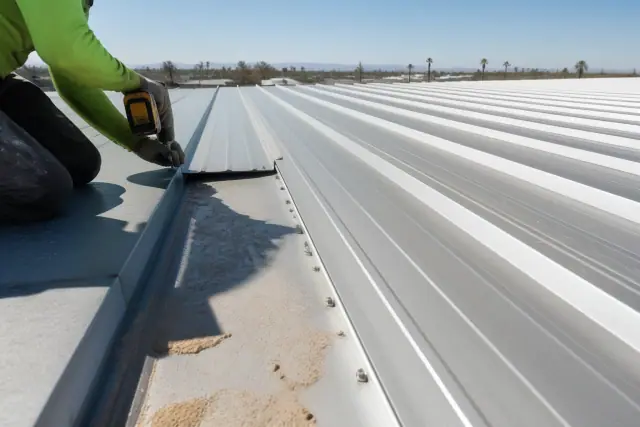
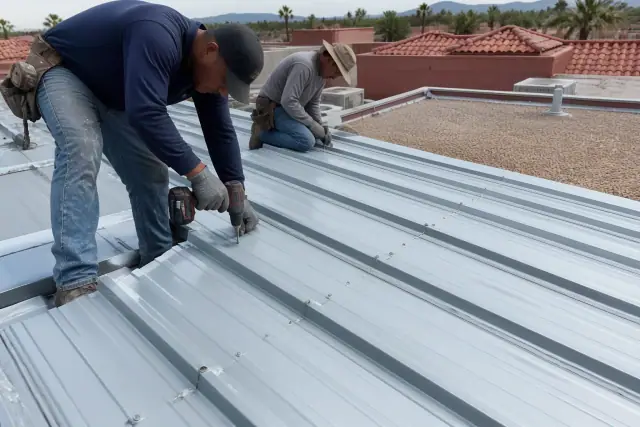
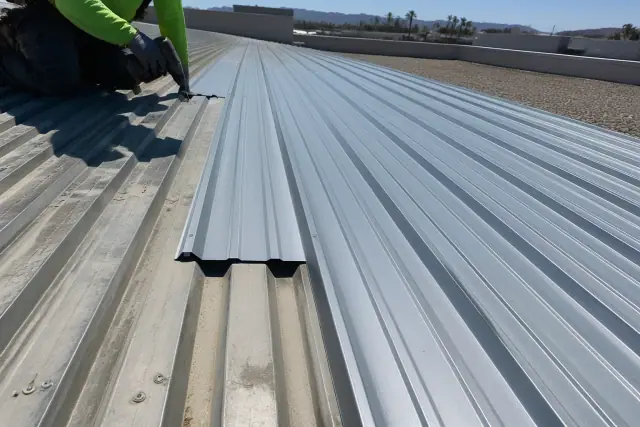
Worker installing metal roofing sheets with industrial screws on a commercial building roof in Phoenix, AZ.

Installation combines the selected panel profile with engineered attachment spacing, butyl sealant at laps, and detailed flashing at penetrations, curbs, and parapet walls. Standing seam applications use concealed clip systems, and seams are mechanically or hand-crimped according to the panel profile and manufacturer specification.

Request Estimate

Metal Roof Replacement

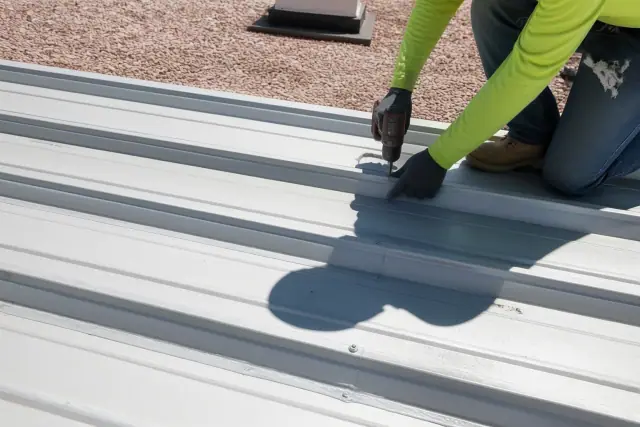
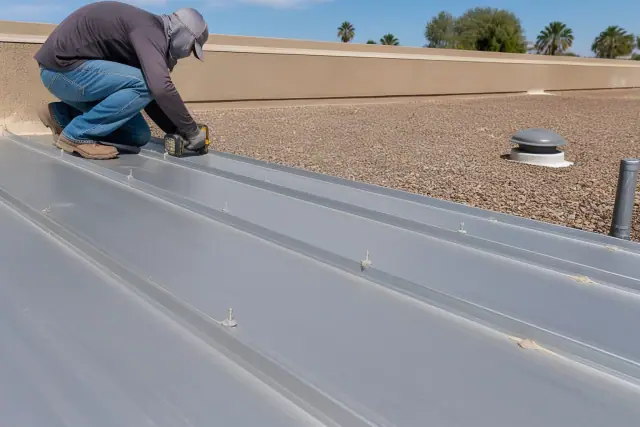
Contractor installing overlapping metal roofing panels with industrial fasteners on a building in Phoenix, AZ.

Replacement is considered when rust-through, delaminating seams, recurring post-storm leaks, or widespread fastener backout show that repairs are no longer stabilizing the roof. Tear-off and installation can be phased in sections, with crane deliveries and material staging coordinated around loading docks and continued occupancy.

Request Estimate

Commercial Metal Roof Repair

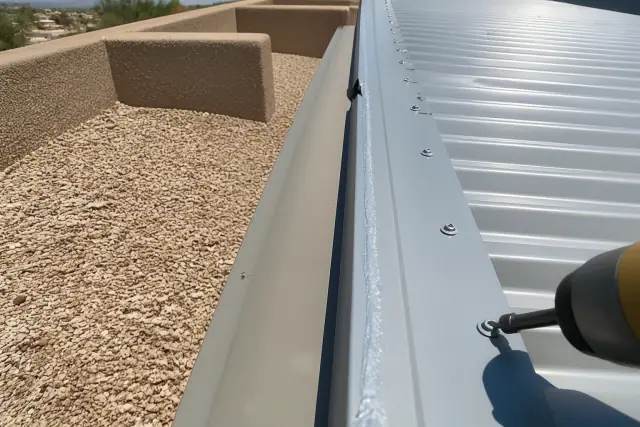
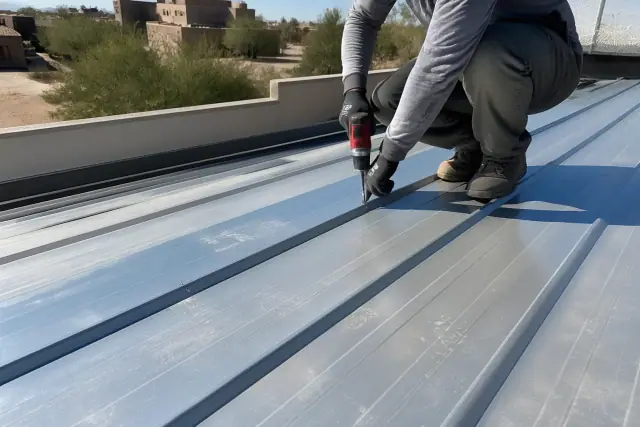
Technicians fastening metal roofing panels with industrial screws and sealant on a building roof in Phoenix, AZ.

Repair work targets the actual leak path or damaged component, including backed-out fasteners, failed panel laps, seam defects, and poorly detailed flashing. The assessment also checks for incompatible metals that can cause galvanic corrosion, such as steel fasteners installed against aluminum panels.

Request Estimate

Roof Inspections and Maintenance

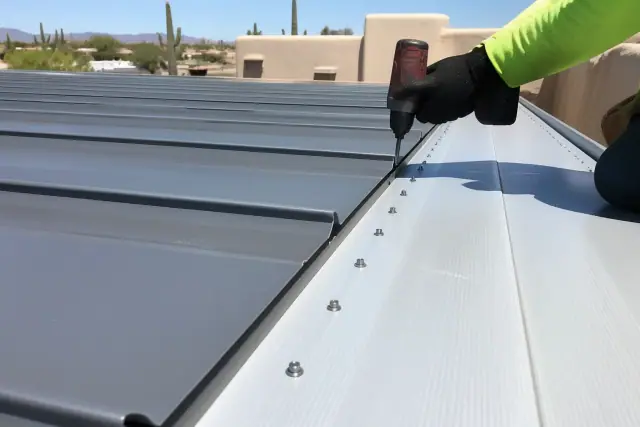
Contractor securing metal roofing panels with stainless steel fasteners on a commercial building in Phoenix, AZ.

Commercial inspections document flashing, drainage, panel or membrane condition, structural attachments, fastener backout, seam separation, and coating wear with photos and a damage percentage. Semi-annual maintenance and an inspection after significant monsoon events can catch punctures, storm damage, and blocked drains before they become interior leaks.

Request Estimate

Commercial Roof Coatings

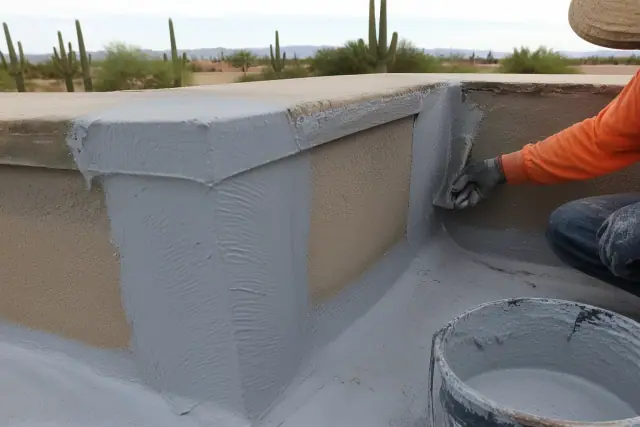
Elastomeric coating applied to a metal roof parapet wall corner in Phoenix, AZ.

Silicone, acrylic, and elastomeric coatings are selected for the existing substrate and ponding conditions. Applied over a clean, dry roof at the manufacturer-specified mil thickness, a reflective coating can extend an aging roof's service life by 10-15 years while lowering surface temperature and shielding the underlying material from UV.

Request Estimate

Flat Roof Repair and Alternatives

Technicians fastening overlapping metal roofing panels with industrial screws on a commercial building in Phoenix, AZ.

Related options include TPO in 45, 60, and 80-mil thicknesses, seamless spray polyurethane foam, modified bitumen repairs, and built-up roofing repairs. TPO seams are heat-welded, spray foam adds closed-cell insulation at the roof surface, and membrane repairs are matched to the existing assembly and failure point.

Request Estimate
Panel and Material Options

Commercial Metal Roofing System Options

Panel geometry controls seam design and fastening, while metal and finish affect corrosion resistance and long-term exposure performance. We compare standing seam, corrugated, and R-panel profiles alongside steel, Galvalume, and aluminum specifications for the building at hand.

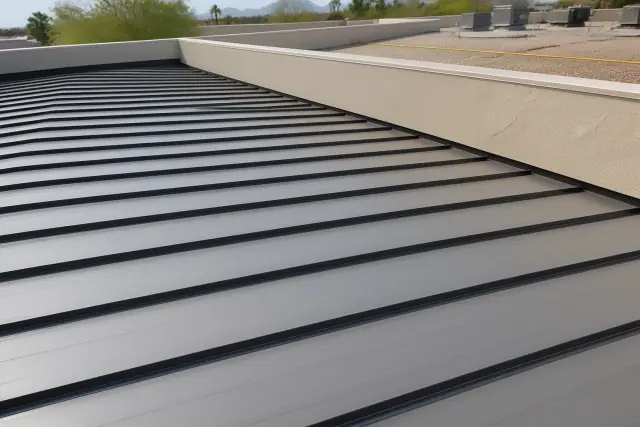
Standing seam metal roofing panels on a commercial building roof in Phoenix, AZ.

Standing Seam Metal Roofing

Standing seam roofs use raised, interlocking seams and concealed clips instead of exposed fasteners through the panel field. The system accommodates the 40-50 degree daily temperature swings that drive repeated expansion and contraction on Phoenix roof decks.

  • Raised, interlocking panel seams
  • No exposed fasteners through the panel field
  • Concealed clips spaced for ASCE 7 wind uplift requirements
  • Mechanically or hand-crimped seams by panel specification
  • Movement capacity for recurring thermal expansion
Request Estimate
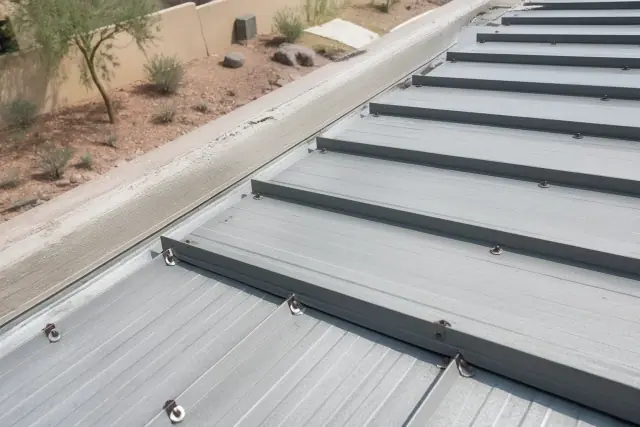
Overlapping corrugated metal roofing panels with industrial fasteners on a commercial roof in Phoenix, AZ.

Corrugated Metal Roofing

Corrugated panels are an exposed-fastener option considered according to roof slope, budget, appearance, and deck conditions. Because fasteners and laps remain central to weather resistance, correct placement, butyl sealant, flashing, and later inspection are especially important.

  • Profile selected for slope and structural deck
  • Exposed-fastener attachment
  • Butyl sealant tape at panel laps
  • Detailed transitions at curbs and penetrations
  • Ongoing fastener and seam inspection
Request Estimate
R-panel metal roofing sheets secured with industrial screws on a commercial building in Phoenix, AZ.

R-Panel Metal Roofing

R-panel is another profile available for commercial metal roofing, chosen according to the building's slope, deck, budget, and appearance requirements. Its exposed-fastener field makes attachment, lap sealing, flashing, and maintenance planning important parts of the specification.

  • Commercial panel profile
  • Gauge matched to expected exposure
  • Fastening planned for local wind conditions
  • Sealed laps and detailed flashing
  • Maintenance focused on fasteners and seams
Request Estimate
Industrial metal roofing panels being fastened on a commercial roof in Phoenix, AZ.

Steel and Galvalume Panels

Steel systems are available in 26-gauge and 24-gauge specifications, including Galvalume-coated panels that meet ASTM A792. Coating selection, including Kynar 500 finishes when specified, helps align corrosion resistance and UV performance with the expected service life.

  • 24-gauge and 26-gauge steel options
  • ASTM A792 Galvalume-coated panels
  • Finish selected for UV and corrosion exposure
  • Compatible fasteners prevent dissimilar-metal contact
  • Available across standing seam, corrugated, and R-panel profiles
Request Estimate
Metal roofing panels being fastened with industrial screws on a building roof in Phoenix, AZ.

Aluminum Metal Roofing

Aluminum systems are considered for coastal or corrosive environments where material compatibility and corrosion behavior drive the decision. The panel profile, finish, fasteners, and surrounding metals must be specified together to avoid preventable galvanic reactions.

  • Selected for coastal or corrosive exposure
  • Profile matched to slope and deck
  • Compatible fasteners reduce galvanic corrosion risk
  • Finish chosen for exposure and service life
  • Flashing detailed at curbs, penetrations, and parapets
Request Estimate
Finding Your Right Fit

Choosing the Right Metal Roofing Approach

The right approach accounts for structural deck condition, drainage, roof slope, building height, wind exposure category, budget, appearance, corrosive conditions, and intended service life. A documented assessment connects those factors to the panel profile, gauge, finish, fastening method, repair scope, or replacement plan.

Phoenix Climate System Design

Specifications address the Sun Corridor's sustained UV, intense heat, thermal movement, dust-storm winds, and monsoon conditions. Coating, gauge, clip spacing, sealants, flashing, and installation timing are selected with those exposures in view.

Commercial Roofing Credentials

Phoenix Commercial Roofing Company holds Arizona Registrar of Contractors licensing, carries full liability insurance, and is bonded for every commercial project it takes on. Crews follow NRCA detailing standards as well as UL 580 wind-uplift, UL 790 fire-classification, and ASCE 7 wind-load requirements applicable to Maricopa County.

Documented Project Planning

Inspection findings are recorded with photos and a damage percentage, while installation planning accounts for permits, International Building Code provisions, municipal review, crane deliveries, material staging, and loading-dock schedules. That documentation helps property teams compare repair and replacement using the roof's measured condition.

What Sets Us Apart

Why Choose Us for Commercial Metal Roof Installation?

Commercial metal roofing succeeds when the field panels, seams, fasteners, flashing, drainage, structural deck, and exposure requirements are treated as one assembly. Our process pairs Phoenix-specific material selection with documented inspections and installation details intended to prevent the failure points commonly found on commercial roofs.

Request Roof Assessment

Fastener Backout

Older exposed-fastener systems can loosen as panels repeatedly expand and contract, opening leak paths at penetrations and laps. An inspection checks fastener seating, surrounding washers, panel condition, and whether a localized repair or broader replacement is warranted.

Seam and Flashing Leaks

Failed seams and incomplete flashing at penetrations, curbs, and parapet walls allow capillary water entry. Repairs must address the actual transition detail and compatible sealant or metal instead of covering the visible interior symptom.

Rust and Galvanic Corrosion

Rust-through and delaminating finishes can signal a roof that is losing serviceability. Galvanic corrosion is a separate preventable problem caused by incompatible metals, such as steel fasteners contacting aluminum panels, so material compatibility is reviewed along with coating condition.

UV and Thermal Cycling

Phoenix's May-through-September summer places sustained heat and UV stress on coatings, sealants, panels, and adjacent membranes. Repeated movement between hot afternoons and cooler desert nights can fatigue poorly detailed connections and separate seams.

Ponding Water and Blocked Drains

Low-slope areas and debris-filled drains can hold water against roofing materials and accelerate breakdown. Cleaning and drainage review are therefore part of preventive maintenance, especially where a metal roof meets flatter membrane areas.

Monsoon Wind and Hail Damage

Monsoon wind gusts and occasional hail can damage attachments, seams, coatings, and flashing even when an interior leak is not immediately visible. Post-storm photos and a documented damage percentage help identify affected areas and support insurance-claim decisions.

How it works

Our Commercial Metal Roofing Process

The process moves from site conditions and measured roof damage to specifications, permits, installation, and an ongoing maintenance plan. Each stage accounts for weather exposure and facility access so the scope is practical for the roof and the business below it.

01.

Assess the Roof and Structure

We walk the structural deck, review existing drainage, identify the roof assembly, and determine the wind exposure category from the building's location and height. Flashing, penetrations, curbs, parapets, seams, fasteners, and surface condition are included.

02.

Document Damage and Scope

Findings are documented with photos and a percentage of the total roof surface affected. If damage exceeds the industry-standard 25% threshold, the comparison weighs planned replacement against the accumulating cost of repeated patch repairs.

03.

Select the System Specification

We compare standing seam, corrugated, and R-panel profiles, then align the metal, gauge, coating, fastening method, and flashing details with slope, exposure, budget, appearance, and expected service life.

04.

Confirm Permits and Scheduling

Permits are pulled through the applicable municipal building department, and the plan is checked against current International Building Code provisions. Crew sequencing, crane deliveries, staging, loading-dock access, and continued occupancy are coordinated before work begins.

05.

Install Around Safe Weather Windows

Panels, clips, seams, butyl sealant, drip edge, and flashing are installed to the selected specification. Panel work is scheduled around monsoon forecasts and avoided during high-wind advisories, when uncured sealant and unsecured panels are vulnerable in the July and August storm windows.

06.

Plan Inspection and Maintenance

The completed roof is supported with inspection and maintenance planning around Phoenix's monsoon season. Scheduled cleaning, debris removal, and checks of drainage, fasteners, seams, flashing, and coatings help find wear before it develops into an active leak.

Plan Your Commercial Roof

Schedule a Commercial Metal Roofing
Consultation

Request a documented assessment for a commercial metal roof installation, repair, or replacement in the Phoenix metro area. We can review the roof's condition, explain panel and material choices, and provide an itemized bid tied to the recommended scope.

Commercial Roof Help

Commercial Metal Roofing FAQs

These answers cover Phoenix commercial metal roof pricing, materials, failure points, inspections, replacement decisions, installation details, and related roof options.

Call Our Roofing Team

Commercial metal roof installation in the Phoenix market generally runs $10 to $20 per square foot installed, depending on panel type, gauge, and roof complexity. Material pricing typically runs $10 to $16 per square foot for standing seam steel, $8 to $15 for aluminum and stone-coated steel, and $7 to $12 for corrugated panels; labor adds another $3 to $8 per square foot depending on deck condition, access, and detail work. Phoenix Commercial Roofing Company provides itemized bids showing how material selection and roof complexity affect the total.

Look for current Arizona Registrar of Contractors licensing, bonding, liability insurance, and documented commercial metal roofing experience. Ask how the contractor chooses panel gauge, fastening method, coating, flashing details, and wind-uplift requirements, and request references from comparable warehouse or industrial projects.

The 25% rule is an industry guideline that treats damage to more than 25% of the total roof surface as a point where full replacement may be more cost-effective and durable than continued patching. Some insurance carriers also use this threshold when considering a repair claim versus replacement, so an inspection report should document the affected percentage rather than rely on a rough visual estimate.

Fastener backout and seam failure are common on older exposed-fastener systems because repeated thermal movement loosens connections and opens leak paths. Poor flashing at penetrations, curbs, and parapets is another frequent cause, while incompatible steel and aluminum components can create galvanic corrosion.

Yes. A drip edge at eave and rake edges directs water away from the fascia and helps keep wind-driven rain from reaching the deck and insulation. It must tie correctly into the gutter or scupper system and the local code-compliant edge detail.

Replacement generally becomes more practical when damage exceeds 25% of the roof surface, the material has passed its expected service life, or repeated repairs do not resolve the underlying leak source. A built-up or modified bitumen roof at 18-20 years old with recurring leaks is typically a replacement candidate, but a documented inspection is needed to compare the actual condition and scope.

Properly installed and maintained steel or aluminum commercial metal roofing can last 40 to 60 years. Achieving that range in Phoenix depends on matching the panel, coating, fasteners, flashing, and maintenance to intense UV, heat, thermal movement, and storm exposure.

Standing seam uses raised interlocking seams and concealed clips, so there are no exposed fasteners penetrating the panel field. Corrugated and R-panel profiles use exposed-fastener details, making fastener placement, lap sealing, and ongoing inspection especially important.

The choice between 26-gauge or 24-gauge steel, Galvalume-coated panels, and aluminum depends on the structural deck, slope, wind exposure, corrosion conditions, appearance, budget, and expected service life. The coating and fastener metals must also be compatible with the panel to avoid premature corrosion.

A properly specified reflective coating can reduce roof surface temperature by 50°F or more compared with dark asphalt or EPDM systems. The effect is especially relevant during Phoenix's long summer, though panel finish, substrate, insulation, and the complete roof assembly all affect building performance.

Semi-annual inspections help catch seam separation, fastener backout, coating wear, punctures, and drainage problems before they become active leaks. An additional inspection after a significant monsoon event can document wind or hail damage and clear debris from drains.

Options in the service lineup include heat-welded TPO, spray polyurethane foam, roof coatings, modified bitumen, and built-up roofing. TPO is available in 45, 60, and 80-mil thicknesses, while spray foam can often be applied over existing built-up roofing, modified bitumen, or metal without a full tear-off when conditions allow.

Yes, tear-off and installation can be phased in sections when the facility must remain occupied. Planning should coordinate crane deliveries, material staging, crew sequencing, and loading-dock access with the warehouse, retail, industrial, or office operation below.