TPO Seam Failures
Seams are the leading leak source. Incorrect welding temperature or speed, dusty or contaminated surfaces, and overlaps below the 1.5-inch manufacturer minimum can leave the joint vulnerable months or years later.
Phoenix Commercial Roofing Company most often finds seam failures, punctures, ponding water, UV and heat degradation, shrinkage, and fastener backout on flat and low-slope commercial roofs in Phoenix. Most defects are repairable when caught early, but Valley heat, monsoon storms, installation shortcuts, and deferred maintenance can turn small problems into active leaks.
Seams are the leading leak source. Incorrect welding temperature or speed, dusty or contaminated surfaces, and overlaps below the 1.5-inch manufacturer minimum can leave the joint vulnerable months or years later.
Roof surfaces regularly reach 170-180°F during July and August, stressing seams and fasteners through repeated thermal cycling. Water that remains for more than 48 hours accelerates membrane breakdown and algae growth, especially where tapered insulation is inadequate.
A spring inspection can find open seams, loose fasteners, and debris before peak heat and monsoon storms. A fall check can document storm damage and confirm that drains, penetrations, and repaired areas remain sound.
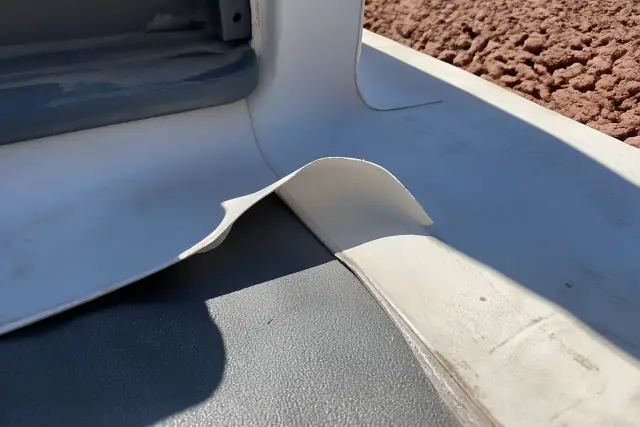
A lifted seam edge on an otherwise intact white membrane can distinguish a weld failure that may be resealed from widespread membrane deterioration.
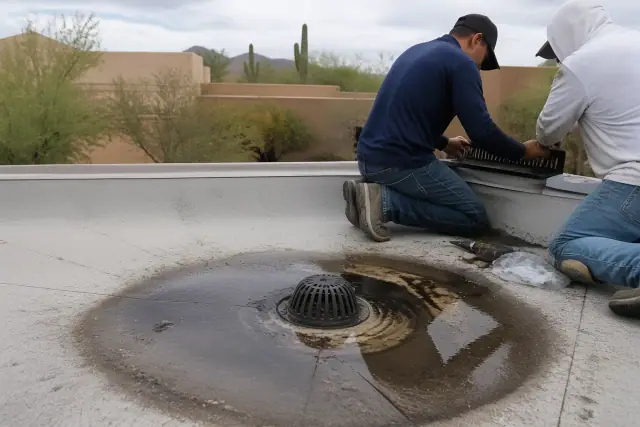
Standing water and residue around a low roof drain after a storm can reveal a drainage or slope problem that must be addressed with the membrane repair.
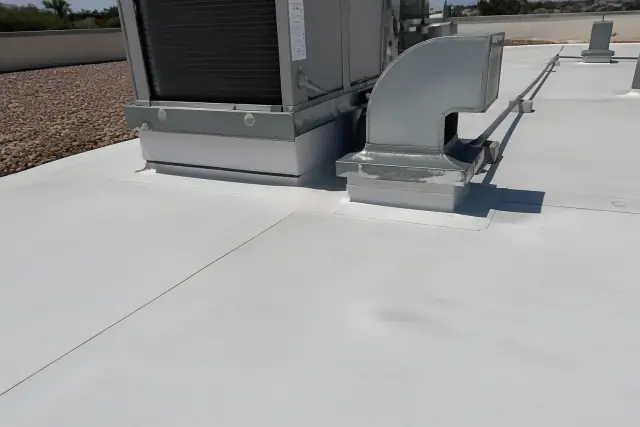
A raised fastener plate telegraphing through a mechanically attached membrane can reveal attachment movement before the fastener punctures the sheet or admits water.
Start where leaks commonly begin: field seams, penetrations, low areas near drains, and routes used by HVAC technicians. Look for open welds, punctures-especially in thinner 45-mil sheets-bubbles, cracks, and exposed fastener outlines.
A flexible, well-adhered membrane with isolated damage is usually a better repair candidate than a brittle sheet with widespread cracking, shrinkage, or failed seams. Tenting at flashings and bubbling over wet insulation signal that the scope extends below the visible surface.
Act when a seam begins to lift, a puncture appears, a fastener backs out, or the same area leaks after storms. Early hot-air welding or patching can keep water from reaching insulation, the roof deck, and interior finishes.
Do not treat a puncture or separated seam with caulk or roofing tar alone. A compatible cover patch or seam repair should be hot-air welded to sound TPO, while drainage, wet insulation, or loose attachment is corrected at the same time.
| Visible condition | Likely issue | Practical next action |
|---|---|---|
| Open or peeling seam | Weak weld, contamination, or thermal stress | Probe adjoining seams and heat-weld the sound membrane |
| Puncture or tear | Foot traffic, debris, or hail damage | Install a heat-welded cover patch |
| Water remaining beyond 48 hours | Drainage or tapered-insulation problem | Correct drainage and repair any softened area |
| Bubbles or lifting | Trapped moisture, gas, or wet insulation | Inspect below the membrane before patching |
| Tenting or visible plate outlines | Shrinkage or fastener backout | Evaluate attachment and reset failed fasteners |
| Chalking, brittleness, or cracks | UV and heat degradation | Measure the affected area to compare repair with replacement |
TPO is a single-ply thermoplastic polyolefin membrane that is heat-welded at the seams and mechanically fastened, fully adhered, or ballasted over insulation board. When the membrane meets ASTM D6878 and installation is sound, problems usually trace to weak welds, improper fastening, climate stress, or deferred maintenance rather than the sheet failing on its own. Many Maricopa County buildings roofed with TPO over the last two decades now show the effects of repeated heat cycles; as surfaces chalk and lose reflectivity, the potential 20-30% cooling-cost benefit of clean, intact reflective TPO also declines. Localized punctures and seams can often be repaired without a full tear-off.
Roof age, membrane thickness, slope, drainage design, attachment method, insulation and deck condition, and building use all affect the recommendation. A 45-mil sheet is more vulnerable to puncture and shrinkage than thicker 60- or 80-mil material, while heavy rooftop HVAC traffic near Sky Harbor creates different wear than limited-access warehouse roofs. On mechanically fastened systems, screw patterns must meet wind-uplift requirements under ASCE 7 and local code; edge security and fire-classification details may also be checked against ANSI/SPRI ES-1 and UL 790. For cost context, installed TPO generally runs $8 to $10.50 per square foot in 2026 pricing, and a typical 1,500-square-foot commercial project ranges from $6,500 to $24,000 depending on tear-off, insulation, and deck condition.
How long does a TPO roof last? Manufacturer warranties commonly run 20 to 25 years, with some premium products rated up to 30 years, while well-installed and maintained Phoenix roofs often perform for 15 to 20 years under extreme thermal stress. Can TPO be repaired? Yes-isolated punctures, failed seams, and loose fasteners can often be cut out, heat-welded, resealed, or reset while flexible surrounding membrane remains in place. Is it reliable in the desert? Yes, when membrane thickness, fastening, welding, drainage, and maintenance are matched to Valley heat and monsoon wind loads; a 60-mil membrane with annual inspection and prompt seam repair should outlast a thinner unmaintained sheet.
Share where the leak or visible damage appears, how long water remains after storms, and whether HVAC or other trades recently accessed the roof. An inspection can determine whether hot-air welding, patching, fastener resets, drainage correction, or replacement fits the membrane's condition.