The Three Most Common Problems
Blistering, separated seams, and failed flashing lead the list on modified bitumen systems across metro Phoenix. Each can create a path for water if damage is allowed to progress.
Phoenix Commercial Roofing Company inspects and repairs modified bitumen systems across the Salt River Valley each week, where extreme roof heat and monsoon downpours can expose blisters, open seams, and flashing failure. Recognizing those patterns early matters because split blisters and separated laps can let water reach the roofing felts below.
Blistering, separated seams, and failed flashing lead the list on modified bitumen systems across metro Phoenix. Each can create a path for water if damage is allowed to progress.
Roof surfaces can climb past 150°F in summer and approach freezing on winter nights. That repeated expansion and contraction fatigues bitumen at seams and penetrations, especially where a torch pass left a marginal lap.
The surface symptom does not decide the scope by itself. An inspection should establish whether the deck and insulation beneath the modified bitumen are still sound before repair or replacement is chosen.
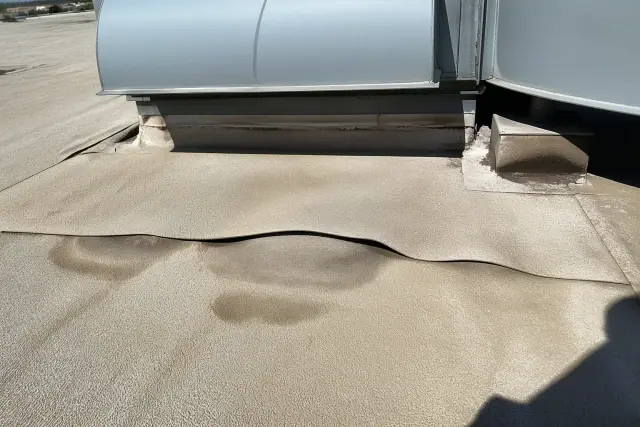
A raised pocket shows where trapped air or moisture has expanded between plies. Once it splits, water can enter the felts below.
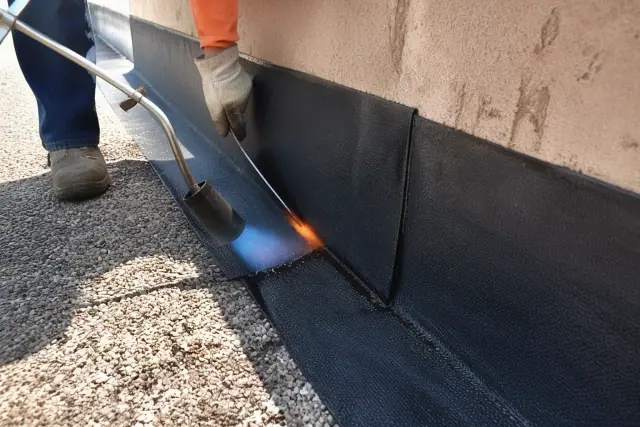
An open seam can reveal an incomplete bond or insufficient overlap between plies. Its linear opening distinguishes the defect from a raised blister in the field of the membrane.
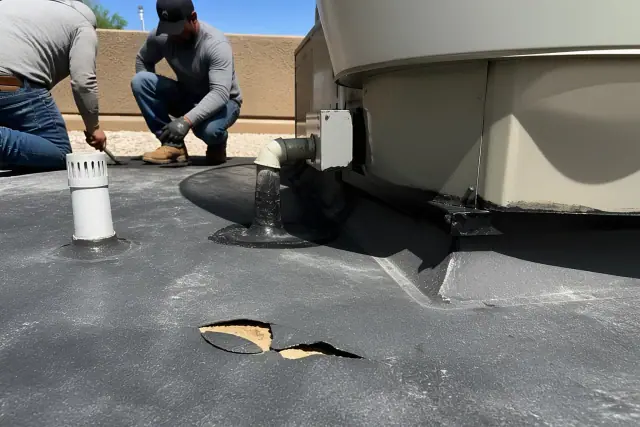
A close view can reveal a tool or foot-traffic puncture in a UV-aged cap sheet. Equipment work areas deserve particular attention when the membrane has lost flexibility.
Look for raised blisters, open laps, punctures, brittle areas, and visible flashing failure. Record where each symptom appears before the roof is evaluated.
UV exposure can make an older uncoated membrane brittle, while foot traffic, dropped tools, and rooftop equipment installation add impact risks. Monsoon downpours then test weakened seams and surface damage.
Many modified bitumen roofs can be repaired when the underlying deck and insulation are sound. The condition beneath the visible defect is therefore central to the decision.
Do not leave a growing blister to split or assume an open lap is only a surface issue. The membrane and the layers below should be checked before the scope is approved.
| Problem | What It Can Mean | Inspection Focus |
|---|---|---|
| Blistering | Trapped air or moisture is expanding and lifting the cap sheet. | Check the blister before it splits and admits water. |
| Open laps or seam separation | The overlap may be insufficient or the torch-applied plies may not be fully fused. | Examine the seam and minimum head lap condition. |
| Thermal fatigue | Repeated expansion and contraction is stressing seams and penetrations. | Look for recurring openings at vulnerable details. |
| Punctures or brittleness | Foot traffic, tools, equipment work, or UV exposure may have damaged flexibility. | Inspect traffic paths and rooftop work areas. |
| Flashing failure | Flashing is one of the frequent failure areas found on these roofs. | Include flashing in the roof evaluation. |
A blister that splits or a lap that opens can move water into the roofing felts, turning a visible membrane defect into damage below the surface. Phoenix thermal cycling also makes marginal seams fatigue earlier than they would in cooler climates, so recurring openings deserve attention.
Most modified bitumen systems last 15-20 years, often less in Phoenix without regular coating and maintenance. Roof age, membrane flexibility, seam condition, and the condition of the deck and insulation all affect the recommendation. Repairs typically run $6-$9 per square foot, while full replacement often falls between $2.75-$6.00 per square foot.
Can a modified bitumen roof be repaired? Often it can when the deck and insulation remain sound. What causes blistering? Air or moisture trapped between plies can expand under heat and lift the cap sheet. How often should a Phoenix commercial roof be checked? Twice-yearly inspections can catch these conditions before they reach the deck.
Share what you have noticed on the roof and where it appears. A local inspection can compare the membrane, seams, flashing, deck, and insulation before a repair or replacement scope is selected.